Become a Founding MemberLearn More
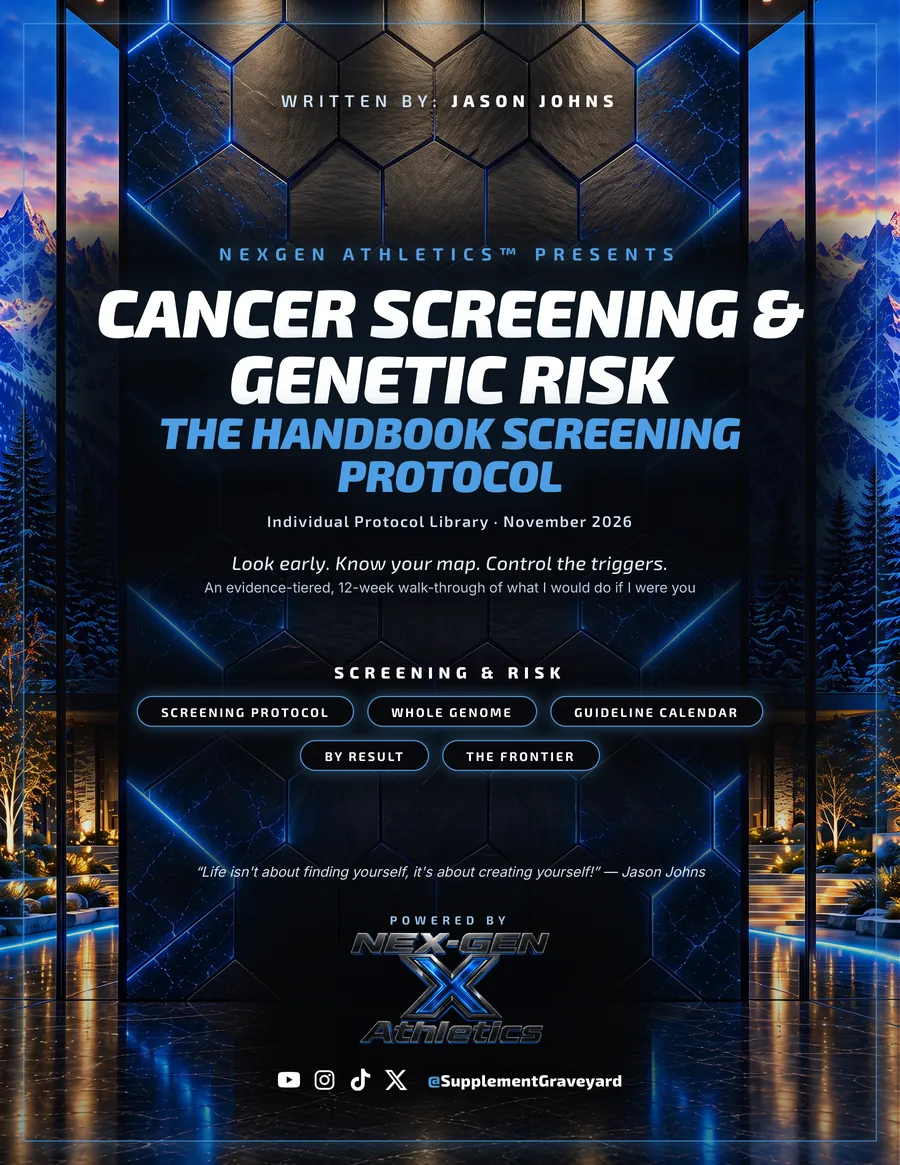
Cover of Cancer Screening & Genetic Risk Protocol — NexGen Individual Protocol Library, by Jason Johns
Individual Protocol · Screening & risk · Available now

Cancer Screening & Genetic Risk: Look Early.

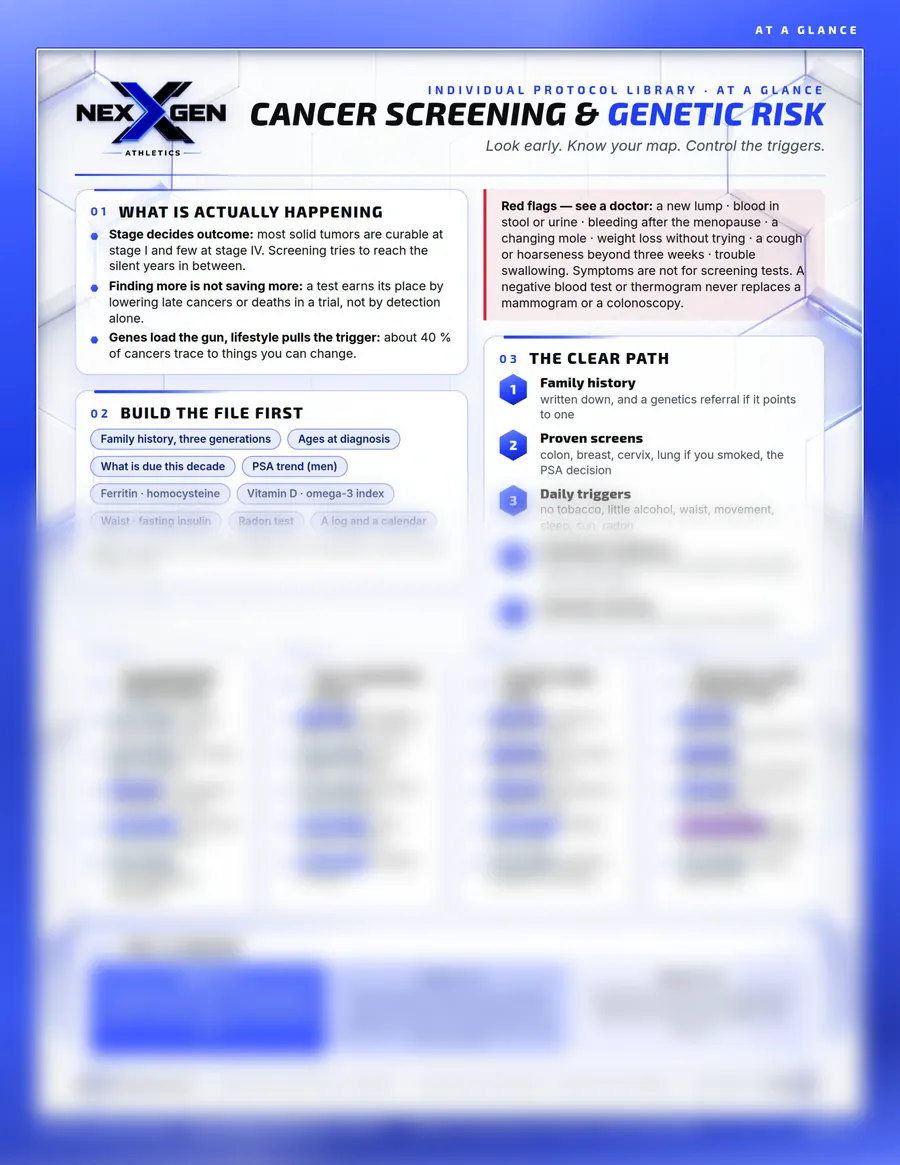
Look early. Know your map. Control the triggers. Thirty-four pages that go above and beyond the cancer screening chapter of the Handbook of Health: all five screening lines, the whole-genome sequence, the six if-then actions and both lifestyle lists, each with the trial behind it and an honest grade; the guideline calendar underneath; what a positive result sets in motion; what it costs; and how to get it ordered.

Any three protocols · $119

Unlocked in the NexGen Protocol app the moment payment clears. The download link also lands on your confirmation page. Written for men and women, every decade.

34pages, letter size
59references, each checked against PubMed
12weeks in three phases
1infographic for the mirror or the fridge

A stand-alone edition that goes above and beyond section 16 of the Handbook of Health: PDF, one-page infographic, A–Z product index and a printable tracking chart. Educational information from an executive health coach, not medical advice.

Who it is written for
  • You have a family history of cancer, or simply want to catch things early, and want to know what to ask for and when
  • You are considering a multi-cancer blood test, a whole-body MRI or a genome and want the honest evidence, the cost and the downside first
  • You are not sure which standard screens are due for your age, or you have put one off
  • You have a result in your hand, a signal, an incidental finding, a raised PSA or a gene, and want to know the next step
Read the red-flag page first if
  • You have a symptom: a lump, bleeding, a changing mole, weight loss without trying or a cough that will not clear. That is a doctor's visit, not a screening test
  • You are being treated for cancer or followed after one, or you carry a known hereditary cancer gene: your specialist's plan comes first
  • You are pregnant, or under 18
  • You are thinking of skipping a mammogram or a colonoscopy because another test was negative: the protocol explains why not to
What’s inside

Thirteen sections. The Handbook's protocol at the core, the evidence next to every line.

Screening is a decision, so the protocol puts the Handbook's schedule at the center and sets what you need to decide around it: what each test finds and misses, what the guidelines say, what a positive leads to, what it costs and what the law protects. Every line is graded honestly, including the ones in the Handbook that have not yet been shown to save lives.

Understand it

  1. Read this first — how to use the protocol, and what it adds to the Handbook
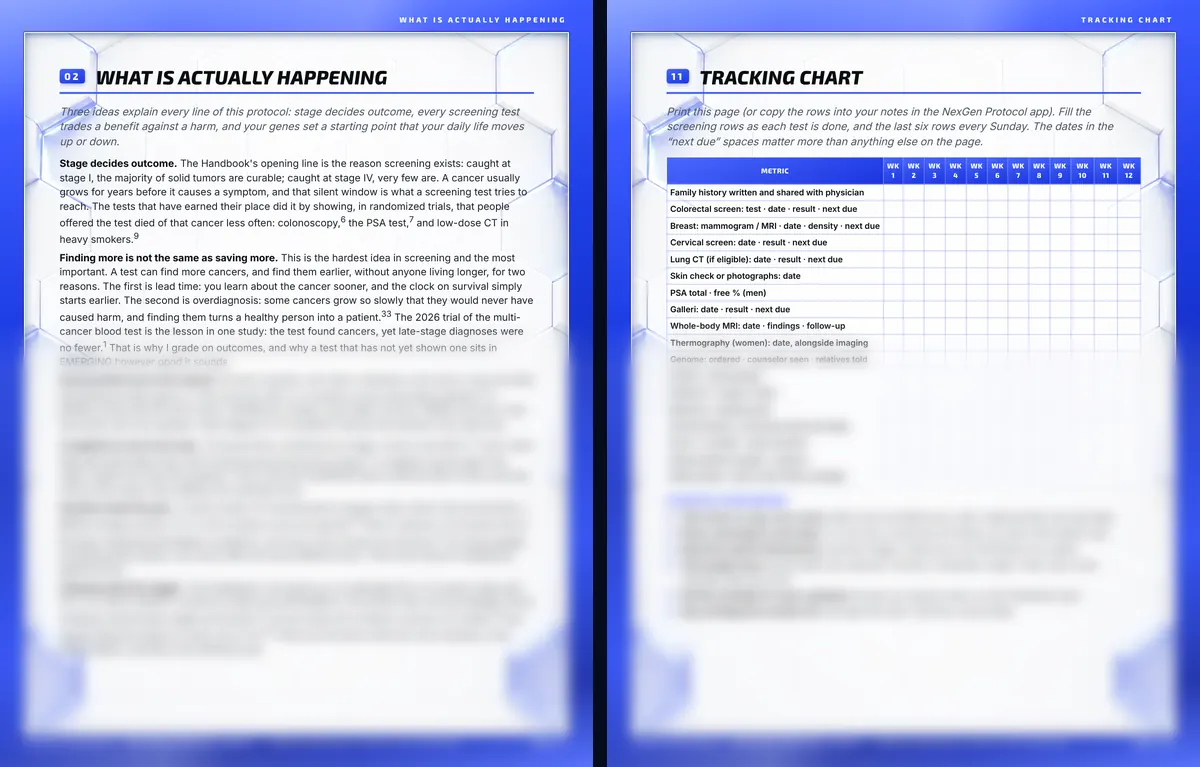
  2. What is actually happening: why stage decides outcome, why finding more is not the same as saving more, false positives and false reassurance, hereditary genes, the share of cancer that is preventable, and a table that points you to your section
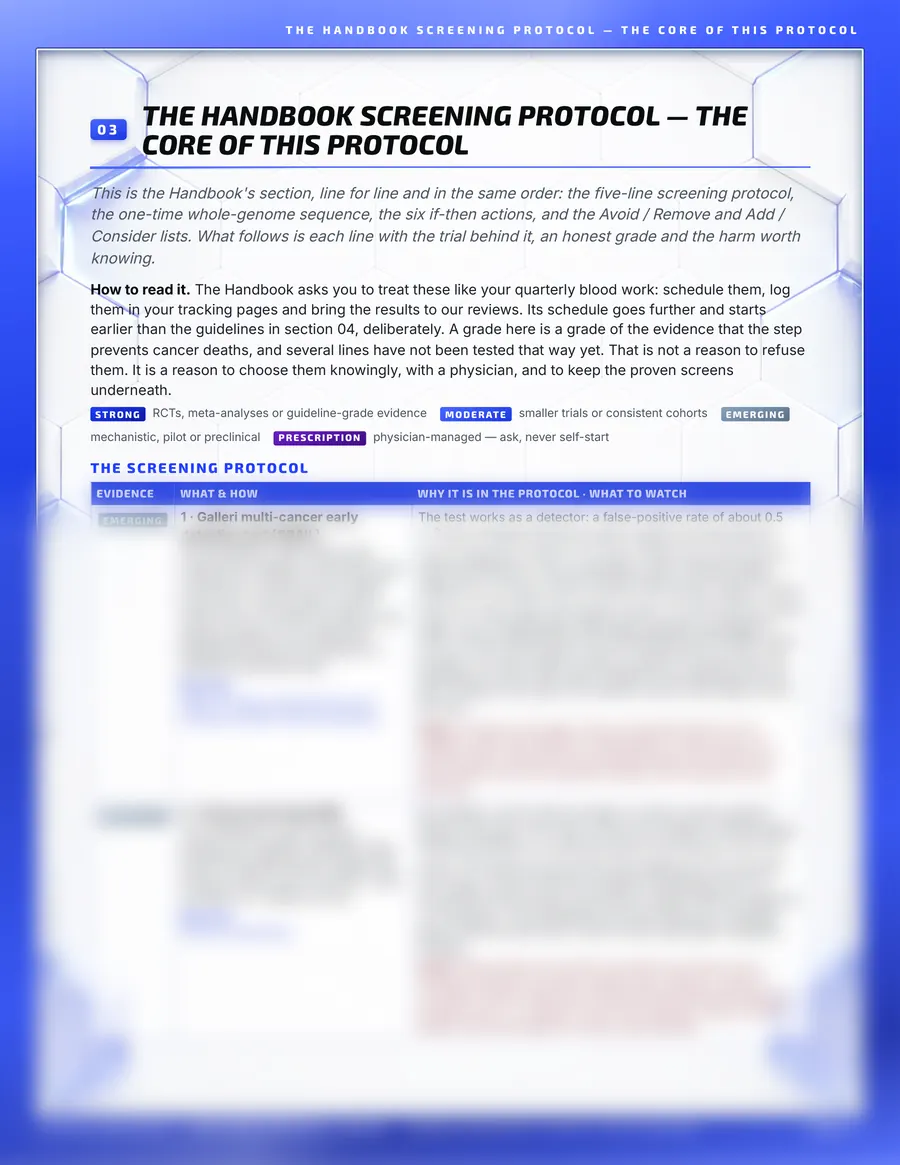
  3. The Handbook screening protocol — the core of this protocol: twenty-four lines in the Handbook's order, covering the five screening tests, the whole-genome sequence, the six if-then actions and the Avoid / Remove and Add / Consider lists, each with its evidence tier and the harm worth knowing

Change it

  1. The guideline calendar by decade: colon, breast, cervix, prostate, lung and skin, set next to the Handbook's additions, with the question to ask for each
  2. What to record & keep on file: the family history done properly, the numbers worth tracking, the screening log, and four decisions to make before a genome
  3. The playbook by result: a cancer signal, an incidental finding, a positive stool test, a rising PSA, dense breasts, a hereditary gene, and what I would skip
  4. Costs, privacy & getting it ordered: current prices, what insurance covers, what genetic privacy law does and does not protect, and what gets a physician to yes

Decide it

  1. Physician-managed options & the experimental frontier: the proven screens, the high-risk clinic, the Galleri decision, other blood tests, software-assisted mammogram reading, polygenic scores and personalized vaccines
  2. What I would do if I were you — the 12-week protocol in three phases, and the clear path in five steps
  3. Red flags — when to see a doctor, plus the interactions table and the questions I would ask at the appointment

Track it

  1. The screening log and 12-week tracking chart
  2. Preferred products & A–Z index
  3. References & disclaimer — 59 citations, each one checked, in a short format: the key studies explained, the rest as a name, one line and a link
The 12 weeks

Build the file. Make the decisions. Close every loop.

The order matters. Phase 1 builds the file and books the proven screens, Phase 2 decides on the Handbook's additions and starts the daily risk reducers, Phase 3 makes sure every result has a next step and every screen has a due date.

Phase 1Weeks 1–2

Foundation

The red flags first. A three-generation family history with ages at diagnosis. A list of what is due from the guideline calendar. One appointment booked, with the questions written down. A radon kit ordered, and the screening log started with everything you have already had.

Phase 2Weeks 3–8

Build

The proven screens done or booked: colon, breast, cervix, lung if you qualify, the PSA decision. Each of the Handbook's additions decided with its grade in front of you. The four decisions before a genome. The blood panel. The daily levers: alcohol, processed meat, movement, sauna, sleep. A week-6 check that every result has a next step.

Phase 3Weeks 9–12

Consolidate

Every loop closed. The genome acted on with the six if-then actions and a hereditary result shared with blood relatives. Radon dealt with. Ten years of due dates in the calendar. Then the questions for next year from the frontier.

How it is built

Tiered, dosed, and honest about the gaps

Every intervention is graded Strong, Moderate, Emerging or Prescription on the human evidence behind it, with the dose, the timing, the harm worth knowing and — where the Handbook of Health names a brand — the exact product I would buy. Where the evidence is thin (the multi-cancer blood test, the whole-body MRI, thermography, the detox and methylation genes, fasting, the detox supplements, and everything on the experimental frontier) the protocol says so instead of selling you on it.

Coach, not clinician

Built to make your physician’s job easier

I am an executive health coach, not your physician. The protocol does not replace your prescriptions or your appointments; it organizes everything around them — the labs to request, the questions to ask, the options to raise, and the interactions a pharmacist would flag — so the appointment is productive and the time between appointments is not wasted.

Delivery

In the app in seconds, yours to keep

Pay once. The protocol is added to your account and appears under Protocols → My protocol library in the NexGen Protocol app, with a fresh download link whenever you need one. Print the tracking chart, put the infographic on the mirror, and bring the PDF to your next appointment. Weekly check-in clients: bring it to the next call and we calibrate it together.

Questions

Before you buy

Is this medical advice?

No. The protocol is educational information from an executive health coach, written as “what I would do if I were you.” It is not a diagnosis, a prescription or a treatment plan. Share it with your physician, especially if you are pregnant, breastfeeding, on prescription medication or managing another condition, and stop anything that produces a new symptom.

Should I have the multi-cancer blood test and the whole-body MRI?

The protocol gives you what you need to decide, and it does not decide for you. Both are in the Handbook's schedule and both are graded EMERGING here, because neither has yet been shown to lower cancer deaths: the blood test's randomized trial, reported in 2026, did not meet its main goal, and no trial of whole-body MRI has measured outcomes. The protocol sets out what each finds and misses, what a positive result leads to, what it costs, and why neither replaces a colonoscopy, a mammogram or a cervical screen. Then it gives you the words to bring it to a physician who will manage the result.

I already own the Handbook of Health. What does this add?

The Handbook gives you section 16 as a chapter: my order of operations and the products I use. This edition goes above and beyond it: every line of the Handbook's screening protocol with the trial behind it, an honest evidence tier and the harm worth knowing, including the 2026 results; the guideline calendar by decade, so you can see what is standard and what goes beyond it; a playbook for every result: a cancer signal, an incidental finding, a positive stool test, a rising PSA, dense breasts or a hereditary gene; the family history done properly, the numbers worth tracking, costs, genetic privacy and how to get tests ordered; a labelled experimental frontier, an interactions table, red flags and a week-by-week plan with a screening log. If you bought this protocol earlier as a chapter edition, the stand-alone edition is already in your account at no cost.

How is it delivered?

The moment your payment clears, the protocol is added to your account. Sign in to the NexGen Protocol app (on the site at nexgenprotocol.app or the Android download) and open Protocols → My protocol library; the confirmation page also shows a download link. It is a 34-page PDF, letter size, with the one-page infographic on page two.

What about the other Individual Protocols?

Every protocol in the library is $49, or any three for $119. The stand-alone editions, like this one, are written to go above and beyond what is in the Handbook of Health. The protocols still sold as chapter editions are being rebuilt the same way, one at a time, and anyone who buys a chapter edition receives the stand-alone edition free when it ships. See the library.

Refunds?

Digital products are non-refundable once delivered. If the file will not open or the link has expired, email supplementgraveyard@gmail.com and I will fix it the same day.

Your copy

Look early. Know your map. Control the triggers.

Twelve weeks, in order, with the tests, the evidence, the costs and the physician conversation spelled out.

Rather have it set up in your home? · $499